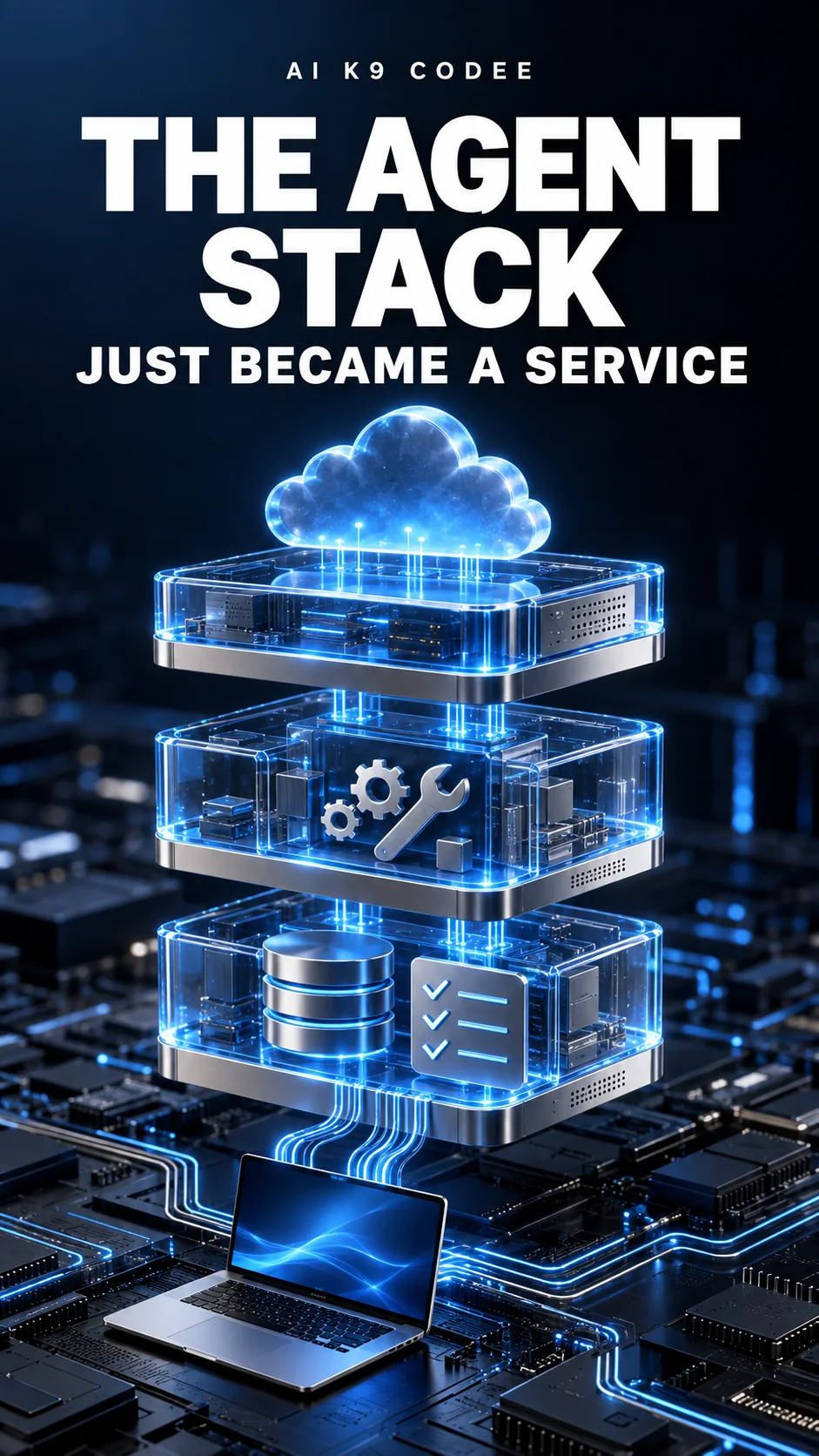
THE AGENT STACK JUST BECAME A SERVICE
For most small businesses, the hardest part of AI has never been finding a model that can write a paragraph.
The hard part is everything around the model.
How does the system remember what it is doing during a long job? Where does it safely run code? How does it work with files? How does it decide which tool to use? What happens when one task needs several specialized workers? How do you keep the work moving if a job takes longer than one conversation?
On September 10, 2026, OpenAI introduced the Agents API in public beta. The announcement matters because it packages many of those “everything around the model” problems into a managed agent harness.
OpenAI says the Agents API is designed to let developers build and run cloud agents with a single API call while using the same broader harness concepts that support Codex and ChatGPT for Work. Developers can choose an OpenAI-hosted sandbox, their own infrastructure, or supported sandbox partners. The API includes support for long-running sessions, tool search, programmatic tool calling and subagents.
That may sound like developer news.
It is also small-business news.
Not because the neighborhood contractor, salon owner, dog trainer, caterer, landlord, nonprofit director or repair shop should immediately start writing agent code.
It matters because infrastructure that once required a custom engineering stack is being standardized.
And when infrastructure becomes standardized, more people can build useful services on top of it.
WHAT AN “AGENT HARNESS” REALLY MEANS
A language model can reason and generate output. A working business agent needs more.
It needs a job.
It needs instructions.
It needs access to the right information.
It needs tools.
It needs a safe place to run.
It needs memory or context management.
It needs rules for what it may and may not do.
It needs a way to recover when work takes a long time.
It may need to divide the job among several specialized agents.
The harness is the layer that organizes all of that.
OpenAI’s Agents API announcement focuses heavily on this operational layer. The company says useful agents need a harness that manages context, uses tools efficiently and coordinates subagents. It also says reliable agents need infrastructure that can stay active through long sessions, work with files, run code and preserve intermediate results.
This is a meaningful shift in where developers spend their time.
Instead of rebuilding the same foundations for every agent, more energy can go toward the workflow itself:
What should the agent do?
What information does it need?
What tools should it be allowed to use?
Where should a person approve the result?
What does successful delivery look like?
That is exactly where small-business value is created.
FIVE CAPABILITIES SMALL BUSINESSES SHOULD PAY ATTENTION TO
1. LONG-RUNNING WORK
Many valuable business tasks do not finish in one prompt.
Research may require several sources. A report may require collecting data, checking files, drafting, revising and packaging. A customer-service workflow may need to inspect an account, verify policy, update a system and prepare a response.
OpenAI says the Agents API includes context management intended to support work that can span multiple context windows. As a session approaches its context limit, the system can compact earlier context while preserving information the agent needs to continue.
For a small business, the concept is important even if someone else builds the implementation.
The future agent is not just a chatbot waiting for the next message. It can be designed around a job that has a beginning, middle and end.
2. SANDBOXES FOR FILES AND CODE
OpenAI is also introducing an OpenAI-hosted sandbox for agents. The announcement describes environments where agents can run code, work with files and produce artifacts.
Developers can also choose their own infrastructure or integrations with sandbox providers including companies such as Cloudflare, Vercel, DigitalOcean, E2B, Modal, Oracle, Runloop and others named in the launch.
The business lesson is simple:
Agents increasingly need a workplace, not just a text box.
A useful agent may need to open a spreadsheet, transform a file, create a document, inspect a folder, calculate something, or produce a deliverable that another person can actually use.
3. TOOL SEARCH INSTEAD OF LOADING EVERYTHING AT ONCE
As agents gain access to more tools, another problem appears: too many tools can make the system slower, more expensive and harder to manage.
OpenAI says the Agents API includes tool search, which can load relevant tool definitions as needed rather than placing every possible tool into context all at once.
That may sound technical, but the principle applies directly to business systems.
A well-designed workflow should expose only what the current job needs.
A booking agent does not need payroll tools.
A content agent does not need access to every customer record.
A housing-intake agent does not need permission to edit accounting data.
Narrow access is not a limitation. It is good system design.
4. PROGRAMMATIC TOOL CALLING
OpenAI also describes programmatic tool calling that can run calls in parallel, chain related operations, filter results and combine outputs before bringing only the useful information back into the model’s context.
This is where “AI automation” starts becoming more than a sequence of prompts.
Imagine a service business that receives a new lead.
An agent could eventually:
collect intake information,
check whether required files were uploaded,
look up the correct service package,
prepare a draft estimate,
identify missing information,
create the customer folder,
and send the owner one clean approval packet.
The owner does not need seven separate AI conversations.
The system does the background organization and surfaces the decision that still requires a human.
5. SUBAGENTS
The Agents API also supports subagents — specialized agents that can work on parts of a larger assignment.
This is an important design idea.
One giant agent that tries to know and do everything may be harder to control than several focused workers.
A content system might use one agent to gather sources, another to summarize evidence, another to assemble SEO fields and another to package the result.
A nonprofit housing system might use separate workers for resource research, landlord information, intake completeness and follow-up preparation.
The main agent becomes a coordinator.
That structure looks much more like a real organization.
THE INDUSTRY IS CONVERGING ON WORKFLOWS, NOT JUST CHAT
OpenAI is not the only company emphasizing agent systems.
On September 10, Anthropic hosted a session on building Claude commerce agents, covering blueprints, guardrails and deployment patterns across retail, travel, telecom and entertainment.
The specific products differ, but the direction is consistent:
AI companies are spending more time on the systems that let models do reliable work.
Earlier this year, OpenAI introduced Presence for enterprise agent deployment with policies, guardrails and escalation rules. OpenAI’s Frontier Alliances announcement also emphasized that successful AI adoption requires workflow redesign, systems integration and change management — not simply access to a stronger model.
That is the bigger story.
The next stage of AI competition will not only be about whose model scores highest.
It will also be about who can turn intelligence into dependable work.
WHAT THIS MEANS FOR A SMALL BUSINESS OWNER
A small business should not respond by trying to automate everything.
Start with one workflow that repeats.
Choose something where the input and output are easy to recognize.
Examples:
A dog trainer receives consultation requests.
A caterer receives event inquiries.
A contractor receives estimate requests.
A nonprofit receives Veteran housing intake.
A real-estate professional receives buyer or seller leads.
A repair shop receives device details, photos and appointment requests.
Then map the job.
INTAKE
What enters the system?
PROCESS
What information must be checked, organized, researched or calculated?
PAYLOAD
What are you producing?
DELIVERY
How does the result reach the customer, staff member, donor, Veteran or partner?
APPROVAL
Where must a human make the final decision?
That fifth question becomes more important as agents become more capable.
Automation without ownership is not the goal.
A better operating system is the goal.
THE FIRST AGENT A SMALL BUSINESS SHOULD BUILD IS BORING
The best first agent is usually not a futuristic digital employee.
It is something boring and measurable.
For example:
“Take a completed catering inquiry, identify missing details, organize the information into our quote template, and prepare a draft response for approval.”
That is better than:
“Run my catering company.”
A narrow job gives you a way to evaluate performance.
Did the agent identify every missing field?
Did it use the correct pricing information?
Did it create the right document?
Did it avoid sending anything before approval?
Did it save time?
Did it make fewer mistakes after the tenth run than after the first?
The more clearly you can answer those questions, the more safely you can expand.
PERMISSIONS WILL MATTER MORE THAN PROMPTS
The agent era increases the value of a skill that does not sound exciting:
permission design.
If an AI system can take action, the owner must decide what access it gets.
Read-only access may be enough for one workflow.
Another workflow may need to create drafts but never send them.
A third may be allowed to update a database only after a person approves.
OpenAI’s Presence product frames enterprise agents around job-specific knowledge, system access, policies and escalation.
Small businesses should borrow that mindset now.
Do not ask only:
“What can AI do?”
Ask:
“What is AI allowed to do in this workflow?”
That question protects customers, employees and the business itself.
WHERE CODEE FITS
The new Agents API reinforces the architecture AI Canine Codee has been moving toward: a system with a clear front door and a defined path through the work.
Codee.chat can operate as an intake layer.
A Codee Site can organize the offer, instructions, resources and calls to action.
QR-connected experiences can move people from a physical flyer, storefront, event, vehicle or piece of merchandise into the correct digital workflow.
Uploads can collect the files required to complete a service.
Behind that front door, the business can define intake, process, payload, delivery and approval.
The important distinction is that Codee does not need to become “one AI that does everything.”
The stronger long-term architecture is a coordinator that connects the right workflow, the right tool and the right specialist at the right time.
Today’s Agents API announcement does not automatically mean Codee is integrated with it.
It means the infrastructure available to build systems like Codee is getting more capable and more standardized.
That lowers the distance between an idea and an operating system.
A PRACTICAL 7-STEP AGENT READINESS CHECK
Before paying someone to build an agent, answer these seven questions:
1. What exact repeated job are we trying to improve?
2. What information does the job require?
3. Where is that information stored today?
4. Which tools or systems are actually necessary?
5. What actions may the agent take without approval?
6. What actions always require a person?
7. What measurable result would prove this system is helping?
If those questions are unclear, you are not ready for more automation.
If they are clear, you may already have the blueprint for your first useful agent.
THE TAKEAWAY
The newest AI announcement is not simply another API.
It is evidence that the infrastructure around agents is becoming a product category of its own.
Context management.
Sandboxes.
Tool discovery.
Programmatic execution.
Subagents.
Permissions.
Approvals.
Long-running work.
Those capabilities make agents easier to build, but they do not eliminate the need for good business design.
In fact, they make business design more important.
When intelligence becomes abundant, the competitive advantage shifts toward knowing what work should happen, in what order, with what information, under whose authority, and with what definition of success.
That is the opportunity for small businesses.
Do not race to create the biggest agent.
Build the clearest system.
Pick one repeated task in your business today and write it as five boxes: Intake → Process → Payload → Delivery → Approval. That is the beginning of an agent-ready workflow. AI Canine Codee is being built around that same systems-first philosophy: give the customer a simple front door, organize the work behind it, and keep the business owner in control of the final result.
SOURCES
1. OpenAI — “Introducing the Agents API” — September 10, 2026
https://openai.com/index/introducing-the-agents-api/
Key factual use: public beta launch; managed agent harness; OpenAI-hosted sandboxes; long-running context management; tool search; programmatic tool calling; subagents; supported sandbox ecosystem.
2. Anthropic — “Building Claude Commerce Agents” — recorded September 10, 2026
https://www.anthropic.com/webinars/building-claude-commerce-agents
Key factual use: industry signal around agent blueprints, guardrails and deployment patterns across retail, travel, telecom and entertainment.
3. OpenAI — “Introducing OpenAI Presence” — July 22, 2026
https://openai.com/index/introducing-openai-presence/
Key factual use: job-specific agent deployment with controlled knowledge, policies, guardrails, approved actions and escalation to people.
4. OpenAI — “Introducing Frontier Alliances” — February 23, 2026
https://openai.com/index/frontier-alliance-partners/
Key factual use: OpenAI’s framing that enterprise value from agents also depends on workflow redesign, systems integration, leadership alignment and change management.