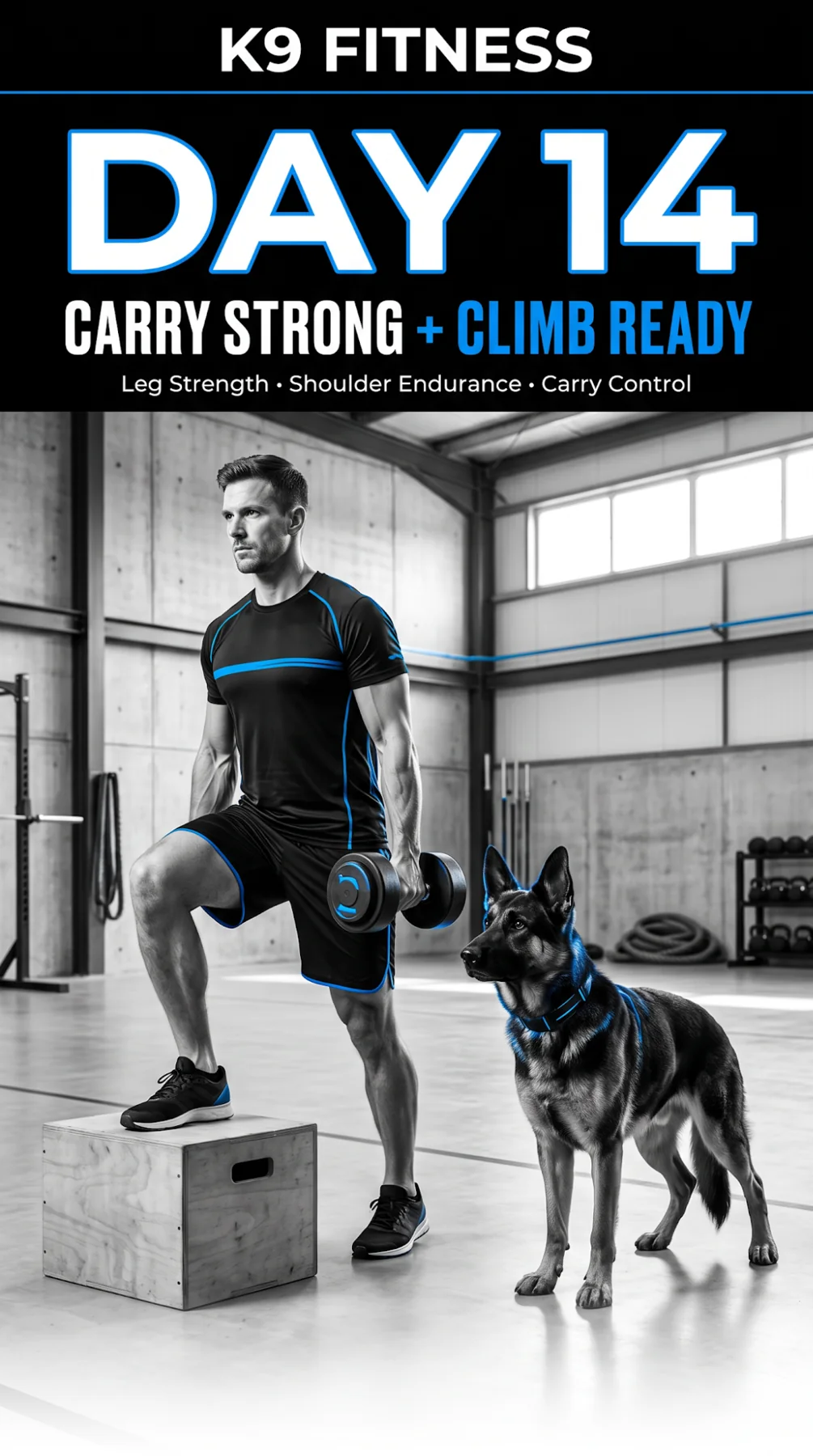
K9 FITNESS — DAY 14 OF 30
CARRY STRONG + CLIMB READY
Leg Strength • Shoulder Endurance • Carry Control
Day 14 is where controlled strength starts looking more like real life. Day 13 slowed the tempo and made you earn every repetition; today keeps that discipline but gives it a practical job: step, hinge, press, and carry without losing your posture. Those patterns show up everywhere outside a workout—climbing stairs with a bag, carrying groceries, lifting a laundry basket, moving equipment, or stepping over a curb while keeping your balance.
Today is not about chasing heavier weights. It is about staying organized while the body manages uneven forces. A step-up asks one leg to create force while the hips and trunk keep you steady; a suitcase carry asks the torso to resist leaning; an overhead press challenges shoulder control while the ribs stay stacked. Put together, these movements build strength that matters because it travels with you.
WHY THIS DAY MATTERS
Unilateral training gives each side of the body a chance to work without requiring maximal loads. It can reveal where balance, coordination, hip control, or shoulder positioning needs more attention, while still training the major leg and shoulder muscles. The goal is not perfect symmetry. The goal is to move each side through a range you can control and to stop a set before fatigue turns good technique into compensation.
SESSION OVERVIEW
• Target time: 35–45 minutes
• Equipment: one or two dumbbells and a low, sturdy step or staircase; bodyweight options are included
• Effort: moderate; finish most strength sets with about 1–3 clean repetitions still available
• Day 14 rule: Carry tall. Step with control.
WARM-UP — 6 MINUTES
Complete two easy rounds. The warm-up should raise your temperature, loosen the ankles and hips, and rehearse the positions you will use later. Move smoothly enough that you could still hold a conversation.
1. BRISK MARCH — 45 seconds
March in place with a relaxed arm swing and gradually higher knees. Stay tall, land softly, and let the pace increase naturally rather than forcing speed.
2. ANKLE ROCKS — 8 per side
Keep the heel planted while the knee travels forward over the toes. Use a wall or chair for balance and stop before the heel lifts.
3. BODYWEIGHT HIP HINGE — 10 reps
Push the hips backward as if closing a car door with your hips. Keep the spine long and feel the hamstrings load without rounding the lower back.
4. STEP-BACK + REACH — 6 per side
Step one foot behind you while reaching both arms forward and slightly upward. Keep the front foot planted and use the movement to open the hips and shoulders without rushing.
5. WALL SLIDE — 8 reps
Slide the arms upward while keeping the ribs controlled. Work only through a pain-free shoulder range; the goal is smooth motion, not forcing the hands as high as possible.
6. ARM CIRCLES — 10 each direction
Begin with small circles and gradually make them larger. Keep the neck relaxed and the motion coming from the shoulders.
BLOCK A — STEP + HINGE + PRESS
3 rounds • Rest 60–75 seconds between rounds
1. DUMBBELL STEP-UP — 8 per side
Use a low, stable step. Place the whole working foot on the surface, lean slightly forward, and drive through that leg to stand tall before lowering under control. Keep the knee tracking in the same direction as the toes and avoid launching yourself upward with the trailing foot. If balance or knee comfort is limited, lower the step height, use bodyweight, or hold a rail.
2. KICKSTAND ROMANIAN DEADLIFT — 8 per side
Place most of your weight on the front leg and keep the toes of the rear foot lightly behind you for balance. Push the hips backward while the dumbbell or dumbbells travel close to the legs. Keep the hips mostly square and stop the hinge when maintaining a long spine becomes difficult. A standard two-foot Romanian deadlift is the easier option.
3. NEUTRAL-GRIP DUMBBELL SHOULDER PRESS — 8–10 reps
Hold the dumbbells with palms facing one another, brace gently, and press overhead through a comfortable range. Keep the ribs stacked over the pelvis so the press comes from the shoulders instead of a backward lean. Use one dumbbell at a time or a high-incline press if overhead work does not feel right today.
4. SUITCASE MARCH — 30 seconds per side
Hold one dumbbell at your side like a suitcase and march slowly in place. The challenge is to stay level rather than leaning away from the load. Keep the shoulders quiet, breathe normally, and make each step controlled. A light household object—or simply a tall unloaded march—works as a regression.
BLOCK B — BALANCE + SHOULDER ENDURANCE
3 rounds • Rest about 60 seconds between rounds
1. SUPPORTED SPLIT SQUAT TO KNEE DRIVE — 6 per side
Hold a wall or rail if needed. Lower into a split squat, stand through the front leg, and bring the rear knee forward into a controlled march position. Pause for a moment at the top so balance becomes part of the exercise instead of something you rush past. Remove the knee drive if it makes the movement unstable.
2. LIGHT REVERSE FLY — 10 reps
Hinge at the hips with very light dumbbells and soft elbows. Move the arms out and slightly back while keeping the neck relaxed. Think about the shoulder blades moving rather than throwing the weights with momentum. No weights or a familiar band pull-apart are appropriate alternatives.
3. CALF RAISE — 15 reps
Rise onto the balls of the feet, pause for one second, and lower slowly. Keep pressure through the big toe and second toe instead of rolling the ankles outward. Use a wall or chair if balance takes attention away from the calves.
4. FRONT-RACK HOLD — 20–30 seconds
Hold two light dumbbells at shoulder level or one dumbbell at the chest. Stand tall and breathe normally without shrugging or flaring the ribs. The load should feel challenging enough to require focus but light enough that posture stays steady for the full hold.
FINISHER — EVERYDAY CAPACITY CIRCUIT
2 rounds • Rest 30–45 seconds between rounds
• Low step-ups — 30 seconds
• Farmer march — 30 seconds
• Wall sit + alternating reach — 20 seconds
• Calf raises — 12 reps
Move steadily rather than racing. A third round is optional only when breathing is controlled, balance remains steady, and the final repetitions still resemble the first ones. The finisher is meant to practice capacity under mild fatigue—not to turn good movement into survival mode.
CANINE PARTNER OPTION — EASY HILL OR STAIR WALK
After the workout, or later in the day, take your dog for an easy 10–15 minute leash walk. If your dog is healthy, comfortable on inclines, and the surface is safe, include a gentle hill or a few normal stairs at a conversational pace. Pause every few minutes for a calm sit or stand so the session reinforces control for both partners rather than becoming a race.
Skip stairs, jumping, weighted vests, or repetitive impact for puppies, senior dogs, dogs with known joint problems, or any dog showing stiffness or discomfort. Bring water in warm weather, avoid hot pavement, and shorten the session when your dog’s breathing, gait, or enthusiasm changes noticeably.
COOLDOWN — 4 TO 5 MINUTES
• Standing calf stretch — 30 seconds per side
• Half-kneeling hip-flexor stretch — 30 seconds per side
• Hamstring hinge stretch — 30 seconds per side
• Cross-body shoulder stretch — 30 seconds per side
• Doorway chest stretch — 30 seconds per side
• Slow breathing — 5 relaxed breaths
RECOVERY NOTE
Day 14 asks the trunk and smaller stabilizers to work harder because several exercises load the body unevenly. That can create a different kind of fatigue than a standard two-leg workout, even when the weights are moderate. Hydrate, eat normally, and give yourself a few easy minutes of walking later in the day. If the legs feel stiff, gentle movement is often more useful than repeatedly forcing deep stretches.
For the shoulders, ordinary muscular fatigue should improve with recovery. Sharp pain, catching, sudden weakness, numbness, dizziness, chest pain, or unusual shortness of breath are not signs to push through. Stop the session and seek appropriate medical guidance when symptoms are concerning or unfamiliar.
DAILY MISSION — MAKE ONE CARRY LOOK CLEAN
At some point today, carry an ordinary object—groceries, a laundry basket, a backpack, or a work bag—with the same posture you practiced in the suitcase march. Keep the torso tall, shoulders level, breathing steady, and steps controlled. Training becomes more valuable when the movement quality follows you out of the workout.
COURSE PROGRESS — DAY 14 OF 30
You are one workout away from the midpoint check. The first two weeks have built a base with squats, lunges, hinges, pressing, shoulder control, balance, tempo work, and carries. Day 14 brings those pieces together in patterns that look more like everyday movement, which is exactly where a foundation should begin paying off.
Tomorrow should not simply be “harder.” Day 15 is the right place for a midpoint checkpoint: repeat a few familiar patterns, compare control and capacity, and use those observations to shape the second half of the course. Progress is not only more weight or more repetitions; cleaner movement, steadier balance, and better recovery count too.
SAFETY NOTE
This workout is general fitness education, not individualized medical care. Choose loads, step heights, ranges, and exercise variations you can control, and use a stable support whenever balance is uncertain. Never use furniture that can slide, tip, or collapse as a step. Stop any exercise that causes sharp pain, dizziness, chest pain, sudden weakness, unusual shortness of breath, or another concerning symptom.
If you have a recent injury or surgery, significant joint pain, or a medical condition that affects exercise tolerance, use appropriate professional medical or rehabilitation guidance before progressing.