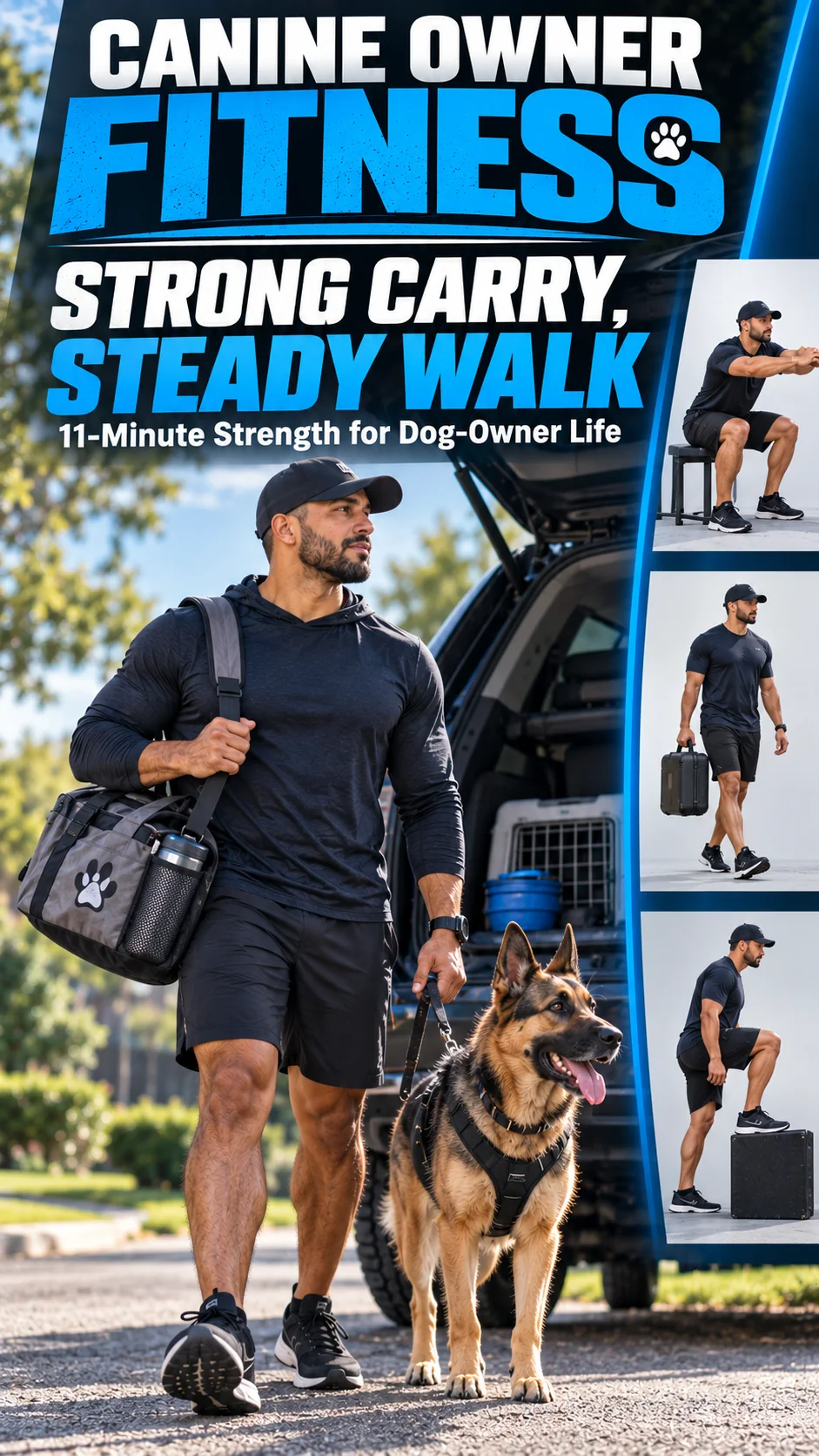
CANINE OWNER FITNESS
Strong Carry, Steady Walk: An 11-Minute Strength Routine for Men Dog Owners
Publication date: October 6, 2026
Audience/focus: Male dog owner focus — useful and welcoming to all adults
Series: Canine Owner Fitness
WHY THIS MATTERS FOR DOG-OWNER LIFE
Dog ownership quietly asks for full-body strength. A normal day can include bending to clip a leash, standing back up, stepping over curbs, carrying food or supplies, moving a crate, loading gear into a vehicle, helping a dog enter a vehicle when it is safe to do so, and waiting on your feet at a veterinary appointment. None of that requires bodybuilding-level strength, but it is easier when the trunk, hips, legs, upper back, and grip work together.
Today’s edition centers men, including dog owners balancing work, parenting or caregiving, household chores, and pet care. The same routine is useful for many women and other adults. The goal is practical strength: carrying awkward gear without leaning hard to one side, rising smoothly from low positions, and maintaining enough upper-body endurance for doors, supplies, and comfortable leash handling. The dog is never used as resistance.
Current U.S. physical activity guidance recommends muscle-strengthening activity at least two days per week, alongside regular aerobic activity, with the major muscle groups included. This 11-minute session is a short complement to a broader fitness routine, not a complete program.
TODAY’S ANATOMY: SIDE-BACK-GRIP SUPPORT
Quadratus lumborum (QL): This deep posterior trunk muscle sits near the lumbar spine and pelvis and is part of the thoracolumbar fascial system. For everyday dog-owner life, think less about isolating it and more about resisting unwanted side-bending when you carry a food bag, water jug, folded crate, or supply tote.
Latissimus dorsi: The lats are broad back muscles that connect to the upper arm and help move the shoulder. They contribute when you draw a bag toward you, stabilize a load close to your body, or close a vehicle hatch. Strong lats support practical carrying; they are not a reason to pull hard on a leash.
Forearm and wrist stabilizers: Forearm muscles help position the wrist and support grip. They matter when holding a leash, carrying supplies, opening containers, or holding a crate handle. Aim for a secure but not crushing grip, with relaxed shoulders and a comfortable wrist position.
THE 11-MINUTE SESSION
Start with 60 seconds of easy preparation. Stand tall, soften your knees, take four or five slow breaths, and gently roll your shoulders. Keep the dog safely outside the workout space unless the dog is calmly resting nearby.
Then complete two rounds of five movements. Work for 45 seconds and use 15 seconds to change positions. Move steadily rather than racing.
1. CHAIR SIT-TO-STAND
Sit on a sturdy chair and stand by driving through the whole foot, then lower with control. Aim for 6–10 smooth reps. This trains the quadriceps, gluteus maximus, and trunk control for getting up after floor-level dog care, rising from a waiting-room chair, and handling household tasks. Easier: use a higher chair or light hand support. Cue: keep the knees tracking generally with the toes.
2. COUNTER PUSH-UP
Place your hands on a stable counter or wall, step back, and keep your body in one long line as you lower and press away. Aim for 6–12 controlled reps. This trains the chest, triceps, shoulders, serratus anterior, and trunk stiffness for pushing doors, cleaning, and managing gear. Easier: use a wall. Cue: keep ribs stacked over the pelvis instead of letting the low back sag.
3. LIGHT SUITCASE HOLD OR MARCH
Hold a light bag, water jug, or lightly loaded backpack in one hand for about 20 seconds, switch sides, then march slowly if balance allows. This trains grip, obliques, deep trunk stabilizers, the QL region, and hips. Dog-owner connection: carrying food or supplies without leaning dramatically to one side. Easier: use no external weight and practice standing tall. Cue: keep the belt line level and head centered over the chest.
4. LOW STEP-UP
Use the lowest safe stair or a stable step. Place the whole foot on it, step up under control, and descend slowly. Aim for 4–8 reps per side. This trains the quadriceps, gluteals, calves, and balance for stairs, curbs, and vehicle-adjacent movement. Easier: perform toe taps while holding a railing or counter. Cue: keep the knee aligned over the foot and do not rush down.
5. SUPPORTED ONE-ARM BACKPACK ROW
Place one hand on a sturdy counter or chair back and hold a very light backpack or reusable bag in the other. Hinge slightly at the hips, keep the back long, and draw the load toward your side without shrugging. Aim for 6–10 reps per side. This trains the lats, rhomboids, rear shoulder, biceps, and grip for moving bags, bowls, and light supplies. Easier: use an empty bag. Cue: keep the neck relaxed.
OPTIONAL CANINE-PARTNER ROUTINE
Your dog does not need to perform the human workout. If your dog is comfortable and healthy enough for a normal walk, finish with a short easy outing focused on your posture and calm handling. Walk at the dog’s comfortable pace, pause for calm stops, and practice smooth direction changes without leash jerks. Never intentionally make the dog pull for resistance. The dog’s age, breed or body structure, health, conditioning, temperature, and walking surface should guide what is appropriate.
REAL-LIFE APPLICATION
Today’s theme is resisting unnecessary twisting and leaning. Keep carried items close to your body and switch sides when practical. For a light crate or bag on the floor, hinge through the hips and knees and avoid combining a lift with a fast twist. If a dog needs help entering a vehicle, first consider whether a ramp, step, harness, or second person would be safer than lifting.
Strength also shows up as endurance at appointments. Standing at check-in, moving between chairs and exam-room positions, or carrying a carrier can challenge the calves, hips, back, and grip. For aging adults, lower-body strength and balance are especially important. CDC guidance for adults 65 and older includes both muscle-strengthening and balance work, and regular activity supports everyday function and independence. Strength training does not guarantee a longer life, but maintaining strength and balance can support mobility and healthy aging.
For dads and other caregivers, practical strength also means organizing the load. A dog bag, family bag, water bottle, and leash can create awkward carrying quickly. Use both hands when possible, make an extra trip when needed, and treat good setup as part of strength.
QUICK SELF-CHECK
After round two, check four things: Could you breathe normally? Could you stay mostly upright during the suitcase hold? Could you step without the knee collapsing inward? Could you keep your shoulders away from your ears during the push-up and row? If not, reduce the load, shorten the range of motion, or use more support next time.
SAFETY NOTE
Stop for sharp or concerning pain, dizziness, or other concerning symptoms. Use appropriate professional guidance for injuries, chronic conditions, recent surgery, major balance problems, or other medical limitations. Choose stable household surfaces and only loads you can control comfortably.
PRACTICAL TAKEAWAY
A stronger dog owner is not someone who can overpower a dog. It is someone who can move their own body and everyday gear with better control. Today’s sit-to-stands, counter push-ups, suitcase holds, step-ups, and rows train legs, trunk, upper back, and grip for walks, stairs, carrying, appointments, household care, and vehicle-related tasks.
SOURCES
CDC — Adult Activity: An Overview
https://www.cdc.gov/physical-activity-basics/guidelines/adults.html
CDC — Older Adult Activity: An Overview
https://www.cdc.gov/physical-activity-basics/guidelines/older-adults.html
CDC — Benefits of Physical Activity
https://www.cdc.gov/physical-activity-basics/benefits/
U.S. Office of Disease Prevention and Health Promotion — Physical Activity Guidelines Questions & Answers
NCBI Bookshelf — Anatomy, Abdomen and Pelvis, Quadratus Lumborum
https://www.ncbi.nlm.nih.gov/books/NBK535407/
NCBI Bookshelf — Anatomy, Back, Latissimus Dorsi
https://www.ncbi.nlm.nih.gov/books/NBK448120/
NCBI Bookshelf — Anatomy, Shoulder and Upper Limb, Wrist Extensor Muscles
https://www.ncbi.nlm.nih.gov/sites/books/NBK534805/
Build the human side of the partnership, too. Follow Canine Owner Fitness for short, practical strength sessions built around real dog-owner life, and explore the broader K9 Fitness and AI Canine Kennel ecosystem for more dog-owner education and everyday canine-focused content.