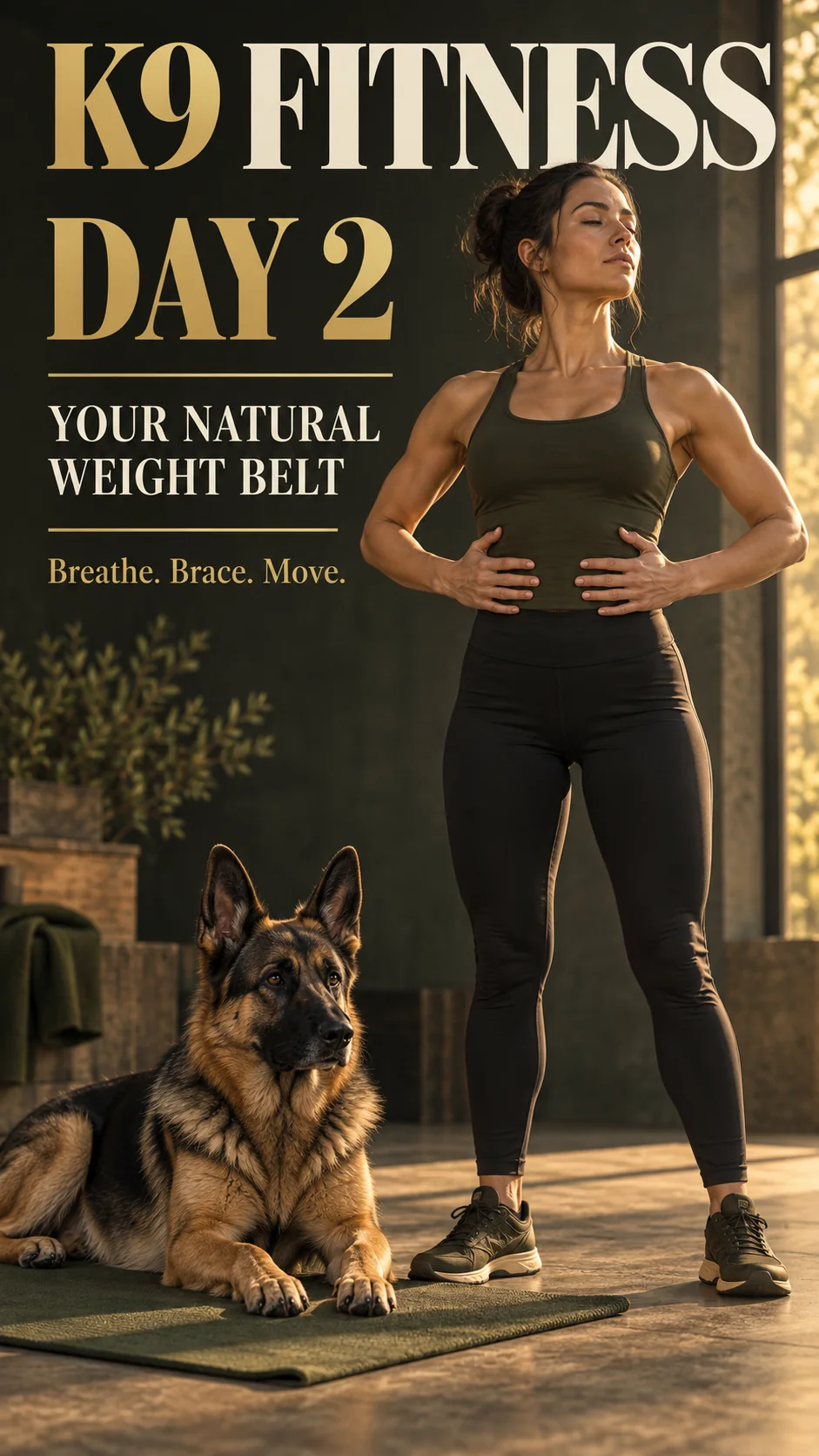
K9 FITNESS — DAY 2: Your Natural Weight Belt
Breathe. Brace. Move.
Imagine carrying a laundry basket without feeling as though every step pulls your body out of position. Today builds on yesterday’s brace and adds hip movement. The aim is coordination: your abdomen supports the task while your glutes help move your hips.
“Natural weight belt” is a teaching metaphor for the abdominal wall, including the transversus abdominis. It does not mean you should suck your stomach in all day or replace every lifting strategy with a tight brace. Practice a gentle effort, breathe through it, and relax fully between sets.
Today’s practice
Begin with 2–3 minutes of easy movement. Use the lowest suggested dose, keep effort comfortable, and rest between lessons whenever needed.
Core brace — 5 breaths. Lie with knees bent; feel the lower ribs expand as you inhale and gently firm your abdomen as you exhale.
Glute bridge — 8 repetitions. Press through your feet and lift your hips only as high as comfortable. Finish with your hips, without forcing your lower back into an arch.
Reverse crunch — 5–6 small repetitions. Bring bent knees toward your trunk with a small pelvic curl. Lower slowly; avoid swinging.
Kneeling side plank — 10 seconds per side. Place elbow under shoulder, bend knees and lift hips. Keep the effort short and steady.
Marching bridge — optional 4 per side. From a low bridge, briefly lighten one foot without letting your pelvis roll. Stay with a normal bridge if that is difficult.
Complete one easy round; add a second only if recovered from Day 1. During a bridge, reduce the height before adding more effort. Today is practice, so use an easy walk instead if your trunk feels tired.
Canine partner routine
Practice three short stop-and-start moments during an easy walk. Stop smoothly, reward your dog for checking in, and continue. Your dog does not need to sit repeatedly, especially if sitting is uncomfortable.
Match activity to your dog’s age, health and conditioning. Avoid hot conditions and hot pavement; stop for unusual fatigue or distress. Ask your vet about activity limits when needed.
Make it useful tomorrow
Could you feel your hips moving while your trunk stayed relatively quiet? Note whether a smaller bridge improved control.
Keep a simple record: movement version, repetitions, effort and next-day response. You do not need a dog or equipment to belong in this course.
Before you train
This is general fitness education, not individualized rehabilitation. Choose pain-free movements; stop for sharp pain, dizziness, chest pain or unusual shortness of breath. If an injury or medical condition affects exercise, use advice from your clinician. Take recovery days between demanding sessions.
Sources and further reading
The sources below provide general background, not validation of this exact workout prescription.
Core training background — Mayo Clinic Health System
General activity guidance — CDC