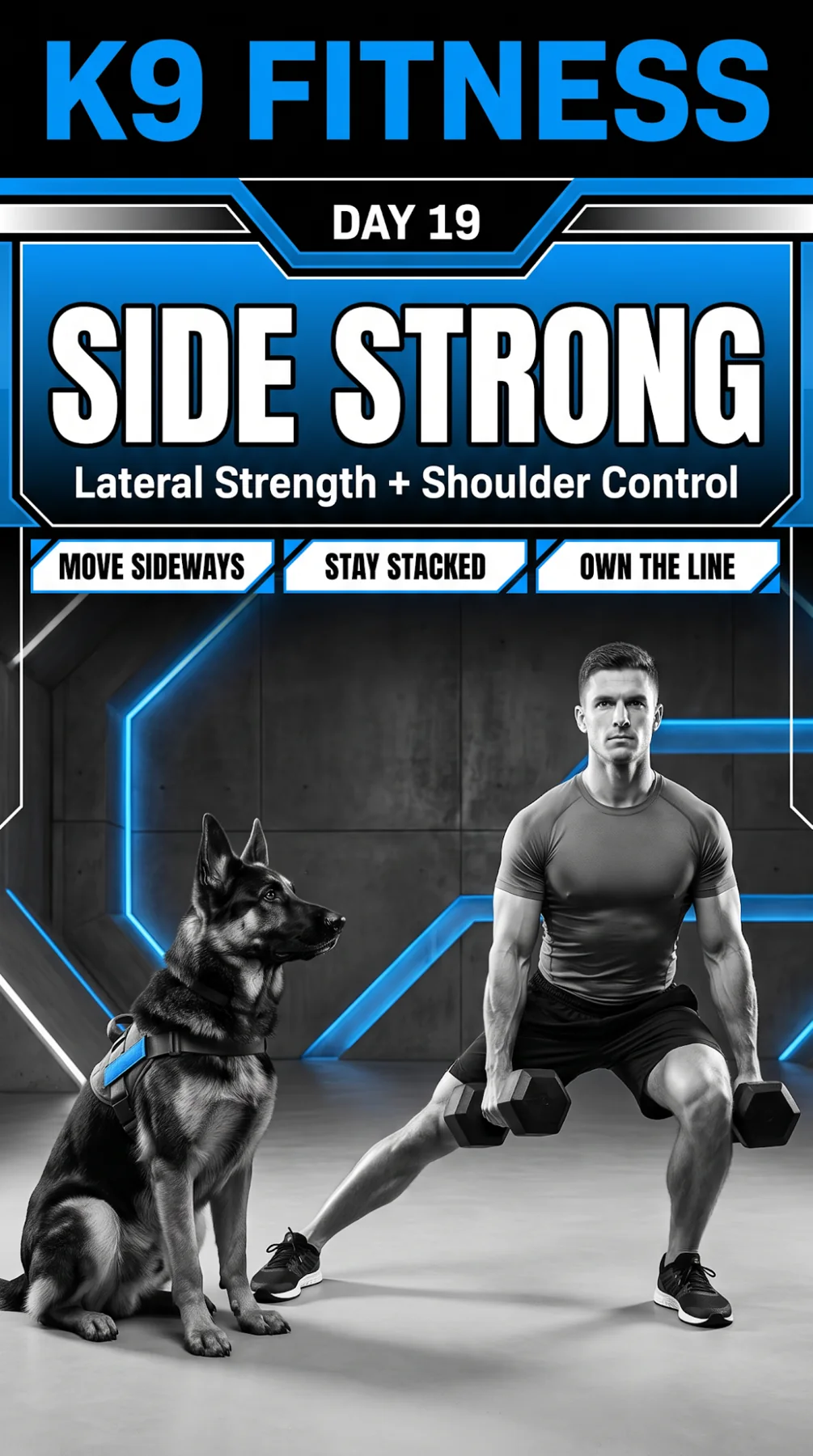
K9 FITNESS — DAY 19 OF 30
SIDE STRONG
Lateral Strength + Shoulder Control
Day 18 taught you to turn controlled movement into upward drive. Day 19 changes the direction. Instead of emphasizing climbing and vertical force, today’s work moves into the frontal plane: side-to-side strength, balance, shoulder control, and the ability to keep the trunk organized while the hips and legs shift laterally. This is an important progression because real life rarely happens only straight ahead. We step around obstacles, change direction on uneven ground, move sideways through tight spaces, and control a leash when a dog changes line.
Lateral training also exposes weaknesses that forward-facing exercises can hide. A squat may feel solid while a side step reveals a knee that collapses inward, a hip that drops, or a torso that leans to compensate. The goal is not to eliminate every difference between sides; small asymmetries are normal. The goal is to notice them, slow the movement down, and build enough strength and control that both sides can perform the task without pain or loss of position.
The shoulder work follows the same theme. Rather than simply pressing overhead again, today asks the shoulder blades, upper back, and trunk to hold clean positions while the lower body moves in new directions. Think of the session as building a stronger “side wall” from the foot through the hip, ribs, shoulder blade, and hand. When those pieces cooperate, movement feels steadier instead of forced.
WHY THIS DAY MATTERS
Day 19 adds frontal-plane strength after two days centered on deceleration and upward drive. That sequence matters. First you learned to absorb force, then to rise with control, and now to manage force when your body moves laterally. The lateral lunge becomes the anchor exercise because it trains the hips, inner thighs, glutes, and foot while asking the knee to track cleanly over the toes. Done well, it builds a skill that carries into stepping around objects, changing direction, hiking on uneven ground, and recovering balance when the surface or environment shifts.
Shoulder control is trained with lighter, deliberate movements instead of heavy grinding repetitions. Reverse flys, lateral raises, front-rack holds, and plank reaches teach the upper body to stay organized while the trunk resists unwanted rotation or side bending. The aim is work capacity and position, not exhaustion. If a light weight lets you move smoothly while a heavier one makes the neck tense or the ribs flare, the lighter weight is the better training choice today.
SESSION OVERVIEW
• Target time: 35–45 minutes
• Equipment: one or two light-to-moderate dumbbells; clear lateral floor space; wall or chair for balance support if needed
• Effort: moderate; finish most strength sets with about 2–3 clean repetitions still available
• Primary focus: lateral leg strength, hip control, shoulder stability, anti-side-bending trunk strength, and balance
• Day 19 rule: move sideways without losing the stacked position of ribs over pelvis
WARM-UP — 6 TO 7 MINUTES
Today’s warm-up prepares the ankles, hips, adductors, glutes, upper back, and shoulders for side-to-side movement. Keep the range small at first. Lateral work can feel unfamiliar even when forward squats and lunges are comfortable, so use the warm-up to find a smooth path rather than forcing depth.
1. EASY WALK OR MARCH — 90 seconds
Start relaxed and gradually increase the pace. Let the arms swing naturally and keep your shoulders away from your ears.
2. SIDE-TO-SIDE WEIGHT SHIFT — 8 reps per side
Stand with the feet wider than hip width. Shift your body weight toward one leg while keeping both feet planted, then return through center and shift to the other side. Keep the movement shallow and controlled.
FORM CUE: Keep the whole foot connected to the floor and let the knee follow the direction of the toes.
3. BODYWEIGHT LATERAL LUNGE REHEARSAL — 5 reps per side
Step or shift to one side, push the hips back, bend the working knee, and keep the opposite leg longer. Return to center by pressing the floor away.
FORM CUE: Hips travel back as the knee bends; chest stays long rather than collapsing forward.
4. ARM CIRCLES — 10 forward + 10 backward
Use a comfortable circle size. The movement should come from the shoulders without aggressive arching through the lower back.
5. SCAPULAR WALL SLIDE — 8 reps
Stand against or near a wall and slide the arms upward through a comfortable range. Keep the neck relaxed and the ribs stacked over the pelvis.
6. HIP HINGE + REACH — 8 reps
Push the hips backward with a soft bend in the knees and reach the hands forward, then stand tall. This prepares the hinge pattern used in the reverse fly.
7. SIDE STEP + SHALLOW SQUAT — 4 each direction
Take one controlled step to the side, settle into a small squat, stand, and bring the feet together. Move slowly enough to keep the knees tracking over the feet.
BLOCK A — BUILD THE SIDE WALL
3 rounds • Rest 60–75 seconds between rounds
The first block builds strength from the ground up. Every exercise asks you to keep the torso organized while one side of the body does more work than the other. Use a load that allows the final repetition of each set to look almost identical to the first. If the knee caves inward, the torso twists, or the shoulder position changes dramatically, shorten the range or reduce the load.
1. GOBLET LATERAL LUNGE — 8 reps per side
Hold one dumbbell close to the chest. Start with the feet wider than hip width or take a controlled step to the side. Sit the hips back over the working leg while keeping the opposite leg longer, then drive through the full foot to return to center.
FORM CUE: Keep heel, big toe, and little-toe base connected to the floor. Let the knee track in the same direction as the toes, and keep the ribs stacked instead of leaning far to the side.
MODIFICATION: Use bodyweight only, shorten the range, or hold a wall or chair. A smaller clean lunge is more useful than a deeper rep that causes pain or loss of balance.
2. BENT-OVER DUMBBELL REVERSE FLY — 10–12 reps
Hold light dumbbells, soften the knees, and hinge at the hips. With the arms slightly bent, open the weights out to the sides until you feel the upper back working, then lower slowly.
FORM CUE: Keep the neck long, chest broad, and shoulder blades moving without shrugging. The weights should stay light enough that the torso does not bounce.
MODIFICATION: Perform one arm at a time with the free hand supported on a bench, chair, or wall.
3. SIDE-STEP SQUAT — 6 reps each direction
Stand tall, step to one side, sit into a controlled squat, stand, then bring the feet together. Repeat in the same direction before switching sides.
FORM CUE: Keep the feet mostly parallel and the knees tracking over the toes. Do not rush the transition between stepping and squatting.
MODIFICATION: Use a shallower squat or perform the movement next to a countertop for light balance support.
4. SINGLE-ARM FRONT-RACK MARCH — 30 seconds per side
Hold one dumbbell at shoulder height in a comfortable front-rack position. March slowly in place while keeping the torso upright and the ribs stacked over the pelvis. Switch arms after 30 seconds.
FORM CUE: Do not lean away from the weight. Keep the breathing steady and the steps quiet.
MODIFICATION: Use a lighter dumbbell or hold the weight lower at chest level if the shoulder position is uncomfortable.
BLOCK B — CONTROL THE LINE
3 rounds • Rest about 60 seconds between rounds
Block B keeps the side-to-side theme but shifts more attention toward balance and shoulder endurance. The movements are deliberately controlled. You are not trying to turn them into a cardio circuit. Give yourself enough time to reset between repetitions so the working knee, pelvis, ribs, and shoulders stay lined up.
1. REVERSE LUNGE TO CONTROLLED KNEE DRIVE — 8 reps per side
Step one foot backward into a comfortable reverse lunge. Press through the front foot to stand and bring the back knee forward to a comfortable height. Pause briefly, then step back into the next repetition.
FORM CUE: Keep the front knee tracking over the toes and finish tall before lifting the knee. The pause should feel balanced, not rushed.
MODIFICATION: Remove the knee drive or keep one hand on a stable support.
2. DUMBBELL LATERAL RAISE — 10–12 reps
Hold light dumbbells by the sides. Raise the arms outward through a comfortable range, usually to or below shoulder height, then lower slowly.
FORM CUE: Lead with the elbows, keep the neck relaxed, and stop before the shoulders shrug toward the ears.
MODIFICATION: Use no weight, one arm at a time, or shorten the range.
3. SIDE-LYING HIP ABDUCTION — 10–12 reps per side
Lie on one side with the bottom knee bent for support and the top leg long. Lift the top leg a small distance without rolling the pelvis backward, then lower under control.
FORM CUE: Keep the toes mostly forward and imagine the heel reaching away as the leg lifts. The movement should come from the outer hip, not from twisting the trunk.
MODIFICATION: Reduce the range or perform standing hip abduction while holding a wall.
4. BEAR PLANK SHOULDER REACH — 6 reps per side
Set up on hands and knees, then lift the knees slightly from the floor. Slowly reach one hand forward a short distance, return it, and switch sides. Keep the hips as quiet as possible.
FORM CUE: Press the floor away, brace gently, and avoid shifting the pelvis dramatically from side to side.
MODIFICATION: Keep the knees on the floor or perform the reach from an incline plank against a bench or countertop.
5. SUPPORTED SINGLE-LEG BALANCE — 20–30 seconds per side
Stand tall near a wall or chair, lift one foot slightly, and hold the position. Keep a soft bend in the standing knee and use only as much fingertip support as needed.
FORM CUE: Keep the pelvis level, foot active, and breathing relaxed. Do not grip the floor with the toes so hard that the foot cramps.
FINISHER — SIDE-TO-SIDE UNDER CONTROL
2 rounds • Rest 45 seconds between rounds
The finisher keeps the intensity modest and asks you to preserve position as fatigue builds. Move with purpose, not speed. If the final 10 seconds of an interval look completely different from the first 10 seconds, shorten the interval or stop early.
• ALTERNATING BODYWEIGHT LATERAL LUNGE — 20 seconds
• FRONT-RACK DUMBBELL HOLD — 20 seconds
• STEP-TOUCH — 30 seconds
• WALL PLANK ALTERNATING REACH — 20 seconds
• EASY MARCH — 30 seconds
Choose a load and range that allow you to breathe continuously. The goal is a steady second round, not a dramatic first round followed by poor form.
CANINE PARTNER OPTION — FIGURE-EIGHT SKILL WALK
If your dog is healthy, comfortable on leash, and already accustomed to regular walks, use a 10–15 minute easy walk as today’s canine partner session. During the walk, choose two safe objects such as cones, trees, or landmarks roughly 8–12 feet apart. Walk a loose figure-eight pattern around them for three or four calm passes, then return to normal walking. Keep the turns wide enough that neither you nor the dog has to pivot sharply.
This activity matches the human workout without asking the dog to perform human exercises. You practice changing direction, organizing your feet, and staying upright while the leash line changes. Your dog practices calm attention, turning, and adjusting pace around a predictable pattern. The value comes from coordination and control, not from speed.
Do not force side stepping, stair sprints, jumping, added weight, or tight repetitive turns. Puppies, senior dogs, dogs with orthopedic or neurologic conditions, and dogs showing limping, stiffness, reluctance, or unusual fatigue should stay with comfortable flat walking and veterinary guidance as appropriate. Heat, cold, paw-surface temperature, hydration, and footing should always determine how much outdoor work makes sense.
COOLDOWN — 5 MINUTES
• EASY WALK — 60 seconds
• ADDUCTOR ROCK-BACK — 6 slow reps per side
• HALF-KNEELING HIP-FLEXOR STRETCH — 30 seconds per side
• STANDING CALF STRETCH — 30 seconds per side
• CROSS-BODY SHOULDER STRETCH — 30 seconds per side
• DOORWAY CHEST STRETCH — 30 seconds
• SLOW BREATHING — 5 relaxed breaths
RECOVERY NOTE
The inner thighs, outer hips, upper back, and shoulders may feel different after today because the session emphasizes directions and stabilizers that forward-facing workouts can underuse. Mild muscular soreness over the next day or two can happen after a new training stimulus. Sharp joint pain, persistent swelling, numbness, or pain that changes your normal walking pattern is a different signal and should not be treated as a normal requirement of progress.
Keep recovery simple. Eat normally, include adequate protein and carbohydrate, stay hydrated, and give yourself a reasonable sleep opportunity. An easy walk or light mobility later in the day is fine if it feels good, but there is no need to add a second leg or shoulder workout. Today’s training effect comes from recovering from the planned work, not from adding more fatigue after it.
DAILY MISSION — OWN THE SIDE STEP
Notice one ordinary moment today when you have to move sideways: stepping around a table, making room in a hallway, moving around a vehicle, or repositioning while carrying something light. Instead of twisting the knee or collapsing into one hip, take a deliberate step, keep the foot planted, and let the hips move with the body. The goal is not to turn daily life into a workout. It is to recognize the same movement principles outside the gym.
If you walk your dog today, practice one or two wide, calm turns without yanking the leash or crossing your feet. Let your feet reposition underneath you as the direction changes. That small skill connects directly to the strength and balance work in the session.
COURSE PROGRESS — DAY 19 OF 30
Day 17 trained the ability to control force on the way down. Day 18 trained upward drive and repeated shoulder effort. Day 19 adds side-to-side strength and trunk control. Together, those three days build a more complete movement foundation: absorb, rise, and change direction without losing position.
Today is also a useful checkpoint for asymmetry. After the workout, note which side felt less stable in the lateral lunge, knee drive, hip abduction, or single-leg balance. Do not immediately double the volume on the weaker side. Instead, keep the same prescribed work and prioritize slower, cleaner repetitions there. The course is building capacity over time, not trying to erase every difference in one session.
As you move into the final third of the program, strength and endurance will overlap more often. The quality standard stays the same: position first, then load, then speed. If you can maintain the line while breathing harder and handling moderate resistance, the strength is becoming more useful.
SAFETY NOTE
This course provides general fitness education and is not individualized medical care. Clear enough floor space to move laterally without hitting furniture, weights, pets, or other obstacles. Use footwear and flooring that provide reliable traction, and keep a wall or stable support nearby if balance is uncertain.
Reduce the depth of lateral lunges if you feel pinching or sharp pain in the hip, groin, knee, or ankle. Shoulder raises and reverse flys should use loads that allow smooth motion without aggressive shrugging, jerking, or leaning. Stop an exercise if you experience sharp pain, dizziness, chest pain, sudden weakness, numbness, unusual shortness of breath, or another concerning symptom. If you have a recent injury or surgery, significant joint or back pain, a condition that affects balance or exercise tolerance, or rehabilitation restrictions, use qualified medical or rehabilitation guidance before progressing.