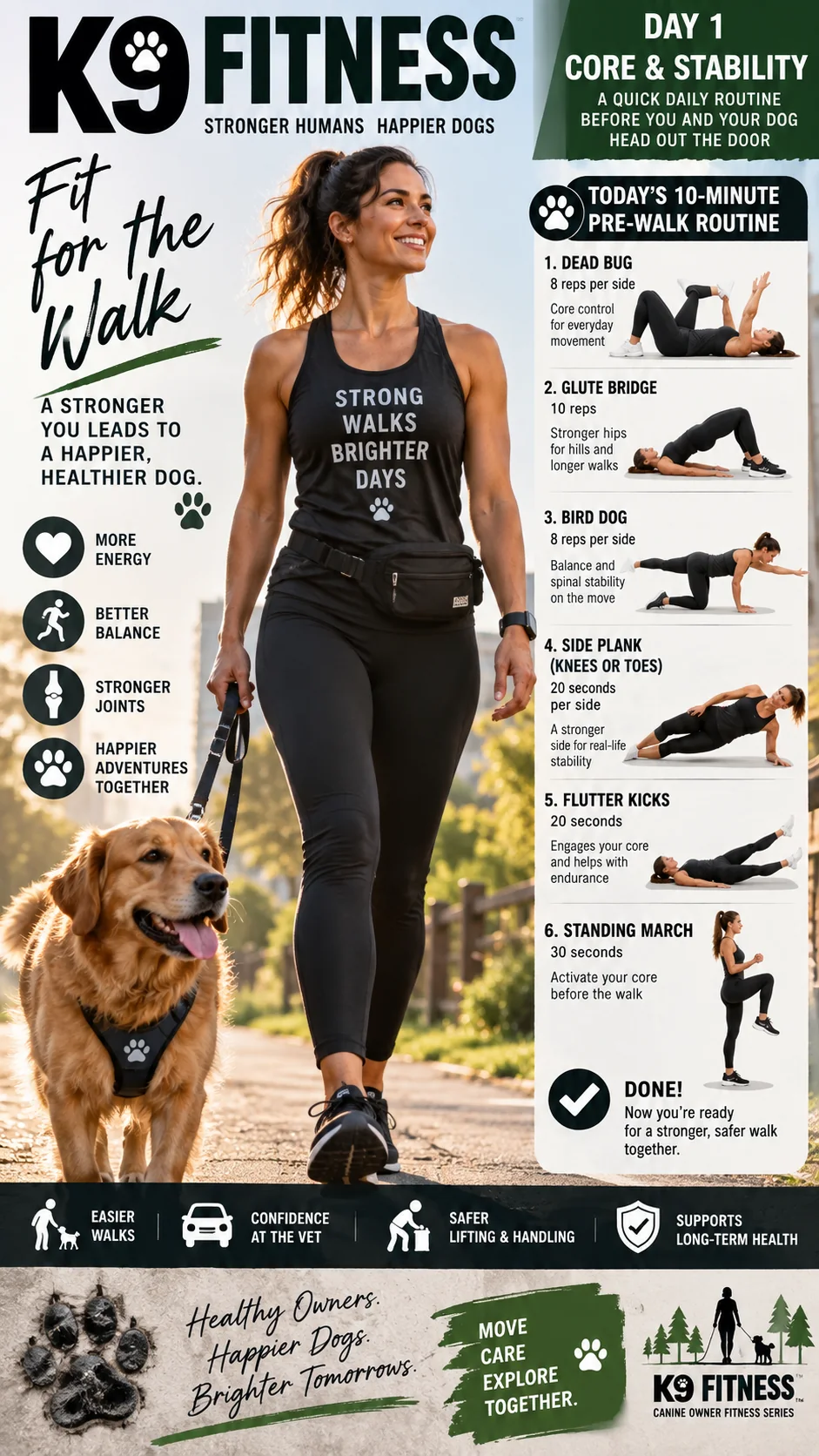
Strong for Every Walk: A 10-Minute Core, Hip & Shoulder Routine for Women Dog Owners
Series: Canine Owner Fitness — Day 1
WHY DOG OWNERS NEED MORE THAN “ABS”
Dog ownership is physical in dozens of small ways that rarely look like a formal workout. You bend to clip a leash, get down to your dog’s level, rise from the floor, step over curbs, carry food and supplies, hold a door while managing the leash, load gear into the car, and sometimes help a dog into or out of a vehicle when it is safe and appropriate. A strong, coordinated body can make those tasks feel more controlled.
For this first Canine Owner Fitness edition, the goal is not a punishing abdominal session. It is a short full-body routine that connects core strength to the hips and shoulders—the areas that help you stay stable when a dog changes direction, when you carry supplies, or when you spend extra time standing at a veterinary appointment. The workout is designed to complement a separate fitness routine rather than replace it.
TODAY’S ANATOMY: THREE MUSCLES MANY ADULTS DON’T THINK ABOUT
Transverse abdominis (TVA): The transverse abdominis is one of the deeper layers of the abdominal wall. The abdominal-wall muscles help stabilize the vertebral column, move the trunk, tense the abdominal wall, and contribute to pressure management. Think of the TVA as part of a 360-degree support system—not as a muscle you should suck inward all day.
Gluteus medius: This broad muscle on the outside of the hip helps stabilize the pelvis when one foot is off the ground. That matters during every walking stride, when stepping over a curb, climbing stairs, or briefly balancing while your dog changes pace.
Serratus anterior: This fan-shaped muscle runs from the ribs toward the shoulder blade. It helps move and stabilize the scapula and contributes to upward rotation during arm elevation. In practical dog-owner terms, it is part of the shoulder system used while pushing a door, reaching for supplies, or maintaining comfortable arm position during leash handling.
TODAY’S 10-MINUTE SESSION
1. 360° CORE BREATHING — 5 SLOW BREATHS
Lie on your back with your knees bent or sit tall in a chair. Inhale gently through your nose and allow the lower ribs and abdomen to expand. Exhale slowly and feel the abdominal wall become firmer without aggressively pulling the stomach inward.
Trains: diaphragm coordination, abdominal-wall awareness, pressure control.
Dog-owner connection: helps you practice staying braced enough to move while still breathing during longer walks, carrying, or standing tasks.
Tip: If your shoulders rise dramatically with every breath, slow down and make the inhale smaller.
2. DEAD BUG — 6 REPS PER SIDE
Lie on your back with your hips and knees bent and your arms pointing upward. Slowly extend one leg and the opposite arm, return to the start, then switch sides.
Trains: transverse abdominis, rectus abdominis, obliques, cross-body coordination.
Dog-owner connection: teaches the trunk to remain controlled while the arms and legs move independently—the same basic challenge that appears during walking.
Tip: Shorten the reach if your ribs flare or your lower back arches substantially.
3. GLUTE BRIDGE — 10 SLOW REPS
Lie on your back with knees bent and feet planted. Gently brace, squeeze the glutes, raise the hips, pause briefly, and lower under control.
Trains: gluteus maximus, pelvic stabilizers, posterior chain, nearby core muscles.
Dog-owner connection: useful practice for standing from low positions, getting up after sitting with your dog, and generating force through the hips instead of asking the lower back to do everything.
Tip: Finish by squeezing the glutes rather than creating a large lower-back arch.
4. WALL PUSH-UP PLUS — 8 TO 10 REPS
Stand facing a wall with hands at about shoulder height. Perform a gentle wall push-up. At the top, keep the elbows straight and allow the shoulder blades to glide slightly forward around the rib cage before returning to neutral.
Trains: serratus anterior, chest, triceps, shoulders, trunk control.
Dog-owner connection: supports the upper-body pattern used when pushing open doors, steadying yourself at the car, or controlling objects while holding a leash in the other hand.
Tip: Keep the motion small and pain-free. Do not shrug toward your ears.
5. CHAIR SIT-TO-STAND — 8 TO 10 REPS
Sit near the front of a sturdy chair with feet planted. Lean forward slightly through the hips, stand tall, then lower back to the chair under control.
Trains: quadriceps, glutes, hips, trunk stabilizers.
Dog-owner connection: builds the practical strength used when getting up from the floor or a low seat, especially after grooming, feeding, or spending time with your dog.
Tip: Use your hands on the chair or thighs if you need assistance. Control matters more than speed.
6. SUPPORTED SINGLE-LEG BALANCE — 15 TO 20 SECONDS PER SIDE
Stand beside a sturdy counter. Lift one foot only a few inches from the floor and hold. Switch sides.
Trains: gluteus medius, ankle stabilizers, deep core, balance.
Dog-owner connection: walking, stepping off curbs, navigating uneven ground, and managing a leash all involve repeated moments of single-leg support.
Tip: Use fingertip support. This is a balance drill, not a test of bravery.
OPTIONAL 90-SECOND FINISHER
20 seconds — forearm plank or elevated counter plank
10 seconds — rest
20 seconds — slow standing march
10 seconds — rest
20 seconds — glute bridge hold
10 seconds — relaxed breathing
Finish while your form is still clean. This series is intended to add useful movement practice to your day, not exhaust you before your main workout.
DOG-OWNER REAL-LIFE APPLICATION
A dog walk is more than leg movement. Each step shifts your weight from one side to the other while the arms move, the shoulder blade responds to the leash position, and the trunk controls small amounts of rotation. If your dog pauses, changes direction, or gets interested in something, your body must reorganize quickly.
That does not mean your dog should become your resistance equipment. Do not intentionally encourage pulling for human strength training. Good owner fitness means your body is better prepared for normal dog-care demands while the dog’s comfort, behavior, age, health, conditioning, temperature, and walking surface remain the priority.
OPTIONAL CANINE-PARTNER ROUTINE: THE 5-MINUTE POSTURE WALK
Take your dog for a comfortable five-minute walk. Keep your shoulders relaxed, the leash managed safely, and your torso upright. Every minute, make one calm stop and one gentle direction change. Notice whether you lean heavily when the dog changes direction or whether you can move your feet and hips while keeping the torso reasonably controlled.
This is not a dog-conditioning prescription. Adjust the walk to your dog’s age, health, body structure, conditioning, weather, and surface conditions. If your dog should not be walking for that duration, complete the human session without canine participation.
WHY THIS MATTERS FOR WOMEN
Strength is useful far beyond appearance. Core, hip, and shoulder strength can support walking, lifting, carrying, balance, posture control, and confidence with everyday physical tasks. For mothers, those same movement qualities can matter when caring for children and dogs in the same day—carrying a child, managing bags, opening doors, and still controlling your own balance.
Postpartum recovery deserves special caution. ACOG says that after a healthy pregnancy and uncomplicated vaginal delivery, many women can begin gentle activity within days or when they feel ready; after cesarean birth or complications, the return-to-exercise timeline should be discussed with an ob-gyn. ACOG also recommends starting with simple postpartum exercises and gradually rebuilding major muscle groups. Pain is a reason to stop rather than push through.
If you are postpartum and an exercise causes significant pelvic heaviness or pressure, worsening leakage, concerning pain, dizziness, or another new symptom, stop and seek individualized guidance.
HEALTHY AGING, BALANCE & INDEPENDENCE
Current CDC guidance says adults should aim for at least 150 minutes of moderate-intensity aerobic activity each week plus muscle-strengthening activity on at least two days. For adults 65 and older, the CDC also emphasizes balance activity. This matters for dog owners because walking a dog can contribute to an active lifestyle, but healthy aging also depends on maintaining strength throughout the legs, hips, back, abdomen, chest, shoulders, and arms.
The goal of Canine Owner Fitness is not to claim that a dead bug, plank, or dog walk guarantees a longer life. Core and strength training are useful pieces of a larger evidence-based picture that includes regular physical activity, balance, recovery, sleep, nutrition, and appropriate medical care.
QUICK SELF-CHECK
Stand beside a counter and perform five slow sit-to-stands, then hold a supported single-leg stance for 10 seconds on each side.
Ask yourself:
Can I breathe normally?
Do I need momentum to stand?
Does one hip feel much less stable?
Do I immediately grab the counter when one foot leaves the floor?
Can I keep my shoulders relaxed rather than shrugged?
Use the answers as a baseline. Progress may show up as smoother movement, steadier breathing, less leaning, or better confidence—not only as more repetitions.
PRACTICAL TAKEAWAY
For a dog owner, useful strength is the ability to walk, bend, reach, carry, stand, and recover balance with control. The deeper abdominal wall, lateral hip muscles, and shoulder-blade stabilizers all contribute. You do not need to train like a bodybuilder to benefit from learning how these systems work together.
SAFETY NOTE
This article is general fitness education, not individualized medical care. Use easier variations as needed. Stop for sharp or concerning pain, dizziness, faintness, chest pain, or other concerning symptoms. If you have a medical limitation, recent surgery, pregnancy/postpartum complication, or condition that affects exercise safety, use appropriate professional guidance.
SOURCES
CDC Adult Physical Activity Guidelines
CDC Older Adult Activity Guidelines
NCBI Serratus Anterior Anatomy
Follow the series
Canine Owner Fitness is built around a simple idea: dog owners deserve fitness education that connects directly to the movements they already perform every day. Follow the series as we alternate female and male dog-owner editions, explore lesser-known muscles, and build practical core, upper-body, and lower-body strength through the broader K9 Fitness and AI Canine Kennel ecosystem.