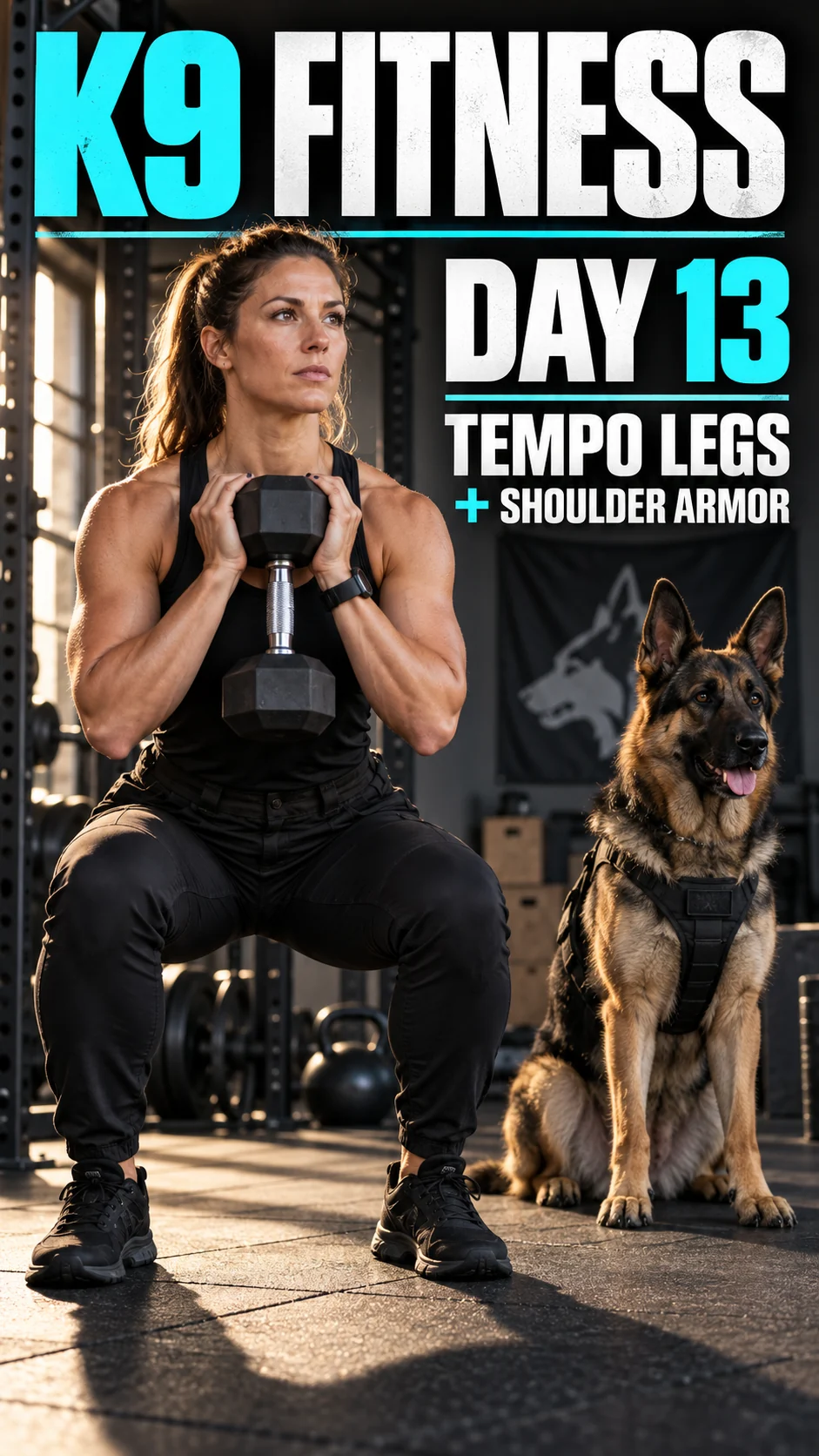
DAY 13 — TEMPO LEGS + SHOULDER ARMOR
Slow Down to Get Stronger
==================================================
EDUCATIONAL INTRO
Day 13 changes the stimulus without abandoning the mission. Day 12 used a strength ladder and stability work. Today shifts toward tempo, control, and shoulder positioning.
The goal is not to race through repetitions. The goal is to make moderate resistance feel more productive by controlling the lowering phase of each movement. A slow eccentric — the portion where the muscle lengthens under load — can make a familiar squat, lunge, or press more challenging without immediately requiring heavier weights.
For the legs, today emphasizes controlled squatting, reverse-lunge mechanics, lateral movement, and hip extension. For the shoulders, the emphasis is not only pressing. We also train the muscles that help position the shoulder blade and upper arm so the shoulder can stay strong and controlled during everyday lifting, carrying, reaching, and training.
Today’s rule: OWN THE REP.
Do not chase speed. Do not add weight simply because the first few repetitions feel easy. Keep the tempo clean and finish each set with one or two technically good repetitions still available.
TOTAL SESSION TARGET: approximately 35–45 minutes
EQUIPMENT: one or two dumbbells preferred; bodyweight alternatives included
INTENSITY TARGET: moderate, controlled, challenging without grinding
==================================================
WARM-UP — 6 MINUTES
==================================================
Complete 2 rounds at an easy pace.
1. ANKLE ROCKS — 8 per side
Stand facing a wall or support. Keep the heel down and gently drive the knee forward over the toes.
FORM CUE: Let the knee travel naturally while the whole foot stays planted.
WHY TODAY: Prepares the ankle for deeper squatting and lunging.
2. SQUAT-TO-STAND — 6 reps
Reach toward the toes, lower into a comfortable squat, raise the chest, then stand.
FORM CUE: Move only through a range you can control without pain.
3. GLUTE BRIDGE — 10 reps
Lie on your back, feet planted, squeeze the glutes, and raise the hips.
FORM CUE: Finish by squeezing the glutes rather than over-arching the low back.
4. SCAPULAR WALL SLIDE — 8 reps
Stand with your back near a wall. Slide the arms upward while keeping the ribs controlled.
FORM CUE: Think “shoulder blades rotate upward,” not “shrug hard.”
5. SCAPULAR PUSH-UP — 8 reps
From a wall, countertop, knees, or plank position, keep the elbows straight and allow the shoulder blades to move together and apart.
FORM CUE: The arms stay long; the movement comes from the shoulder blades.
6. MARCH IN PLACE — 30 seconds
Use relaxed arm swings and gradually raise the knees.
==================================================
BLOCK A — TEMPO STRENGTH
3 ROUNDS
==================================================
Rest 45–75 seconds between rounds.
1. 3-SECOND GOBLET SQUAT — 8 reps
TEMPO: 3 seconds down, brief pause, stand with control.
Hold one dumbbell at chest level. Sit between the hips while keeping the whole foot connected to the floor.
FORM CUES:
• Lower for a true three-count.
• Keep knees tracking in the same general direction as the toes.
• Brace before descending.
• Drive through the floor to stand.
BODYWEIGHT OPTION: Use the same tempo with arms extended forward.
2. HALF-KNEELING SINGLE-ARM DUMBBELL PRESS — 8 per side
Kneel with one knee down and the opposite foot planted. Press one dumbbell overhead.
FORM CUES:
• Squeeze the glute on the kneeling side.
• Keep the ribs stacked over the pelvis.
• Press smoothly; do not lean sideways to finish the rep.
LIGHTER OPTION: Use a very light dumbbell or perform a controlled arm press without load.
3. REVERSE LUNGE — 8 per side
Step backward and lower under control, then drive through the front foot to return.
TEMPO: approximately 2–3 seconds down.
FORM CUES:
• Keep most of the pressure through the front foot.
• Take a long enough step that you can lower without collapsing forward.
• Use a support for balance if needed.
REGRESSION: Perform split squats while holding a chair or countertop.
4. INCLINE PUSH-UP PLUS — 10 reps
Perform an incline push-up on a sturdy countertop, bench, or wall. At the top, gently push a little farther so the shoulder blades move around the ribs.
FORM CUES:
• Keep the body in one line.
• Do not shrug the shoulders toward the ears.
• Make the “plus” small and controlled.
==================================================
BLOCK B — SIDE-TO-SIDE LEGS + SHOULDER CONTROL
3 ROUNDS
==================================================
Rest about 60 seconds between rounds.
1. LATERAL LUNGE — 8 per side
Step to the side, sit the hips back over the working leg, then push the floor away to return.
FORM CUES:
• Keep the planted foot flat.
• Think “hip back” rather than dropping straight down.
• Use a shorter step if mobility is limited.
2. HIP THRUST OR FLOOR GLUTE BRIDGE — 12 reps
Use a bench for hip thrusts if you already know the setup, or stay with floor bridges.
TEMPO: 2 seconds up, 2-second squeeze, controlled lower.
FORM CUES:
• Keep chin gently tucked.
• Finish with the glutes.
• Stop if the movement causes low-back pain.
3. LEAN-AWAY OR STANDARD LATERAL RAISE — 10 per side
Use a light dumbbell. Raise the arm out to the side only as high as you can control comfortably.
FORM CUES:
• Lead with the elbow rather than throwing the hand upward.
• Keep the neck relaxed.
• Use light weight; this is a control exercise.
REGRESSION: Perform both arms together with very light weight or no load.
4. BENT-ELBOW EXTERNAL-ROTATION HOLD — 20 seconds
Keep the elbows bent near the ribs. Gently rotate the forearms outward against a light band if available, or create mild outward tension without equipment.
FORM CUES:
• Keep shoulders down and relaxed.
• Do not force range.
• Think “upper-back control,” not maximal effort.
==================================================
BLOCK C — CONTROLLED CAPACITY FINISHER
2 ROUNDS
==================================================
Move steadily, not frantically.
1. SPLIT-SQUAT ISO HOLD — 20 seconds per side
Lower into a comfortable split-squat position and hold.
FORM CUE: Stay tall and keep the front foot planted.
2. FARMER MARCH — 30 seconds
Hold dumbbells at the sides and march slowly in place.
FORM CUES:
• Stand tall.
• Keep shoulders gently set without shrugging.
• Move slowly enough that the torso does not sway.
NO-WEIGHT OPTION: March while maintaining tall posture and lightly squeezing fists.
3. BEAR-PLANK SHOULDER TAP — 6 per side
From hands and knees, hover the knees slightly off the floor and tap the opposite shoulder.
FORM CUES:
• Keep the hips as still as possible.
• Widen the feet/knees for more stability.
REGRESSION: Perform shoulder taps from a high countertop or from hands and knees without hovering.
4. CALF RAISE WITH 2-SECOND TOP HOLD — 12 reps
Rise onto the balls of the feet, pause two seconds, and lower slowly.
FORM CUE: Use a wall for balance and avoid rolling the ankles outward.
OPTIONAL THIRD ROUND: Only if technique remains clean and energy is good.
==================================================
COOLDOWN — 4 TO 5 MINUTES
==================================================
1. QUAD STRETCH — 30 seconds per side
2. HALF-KNEELING HIP-FLEXOR STRETCH — 30 seconds per side
3. CALF STRETCH — 30 seconds per side
4. CROSS-BODY SHOULDER STRETCH — 30 seconds per side
5. DOORWAY OR WALL CHEST STRETCH — 30 seconds per side
6. SLOW BREATHING — 5 relaxed breaths
RECOVERY NOTE
Today creates difficulty through time under tension rather than maximal load. Expect the legs to feel worked even if you used lighter dumbbells than usual. Hydrate, eat normally, and prioritize sleep. If the shoulders feel unusually irritated rather than simply fatigued, reduce overhead work in the next session and keep the range pain-free.
A useful recovery check later today: walk up a flight of stairs and reach both arms overhead. General muscular fatigue is normal. Sharp pain, catching, sudden weakness, dizziness, or symptoms that feel abnormal are reasons to stop training and seek appropriate medical guidance.
==================================================
DAILY MISSION
==================================================
OWN THREE PERFECT REPS.
During every exercise today, identify the three repetitions that felt the most controlled. Notice what made them better: foot pressure, breathing, slower lowering, bracing, or shoulder position.
The course is teaching more than exercises. It is teaching how to recognize a quality repetition.
==================================================
COURSE PROGRESS NOTE
==================================================
DAY 13 OF 30
The first portion of the course built consistency and exposed the body to repeated leg-and-shoulder training using simple strength patterns. Day 12 used a ladder format to combine strength and stability. Day 13 intentionally slows the session down.
This is a progression even when the dumbbells are not heavier.
Progress can come from:
• more load,
• more repetitions,
• more range of motion,
• better balance,
• slower tempo,
• cleaner technique,
• shorter rest,
• or improved control.
Today focuses on tempo and control so the course does not become a daily race to add weight. That foundation will make future strength and power days more useful.
==================================================
SAFETY NOTE
==================================================
This workout is general fitness education, not individualized medical care. Use loads and ranges that you can control. Stop an exercise if you experience sharp pain, sudden weakness, dizziness, chest pain, unusual shortness of breath, or another concerning symptom. If you have an injury, medical condition, recent surgery, significant joint pain, or uncertainty about exercise readiness, use appropriate professional medical or rehabilitation guidance before progressing.
For shoulder exercises, pain-free control matters more than reaching a specific height. For leg exercises, use a wall, rail, or sturdy support whenever balance is uncertain.
==================================================