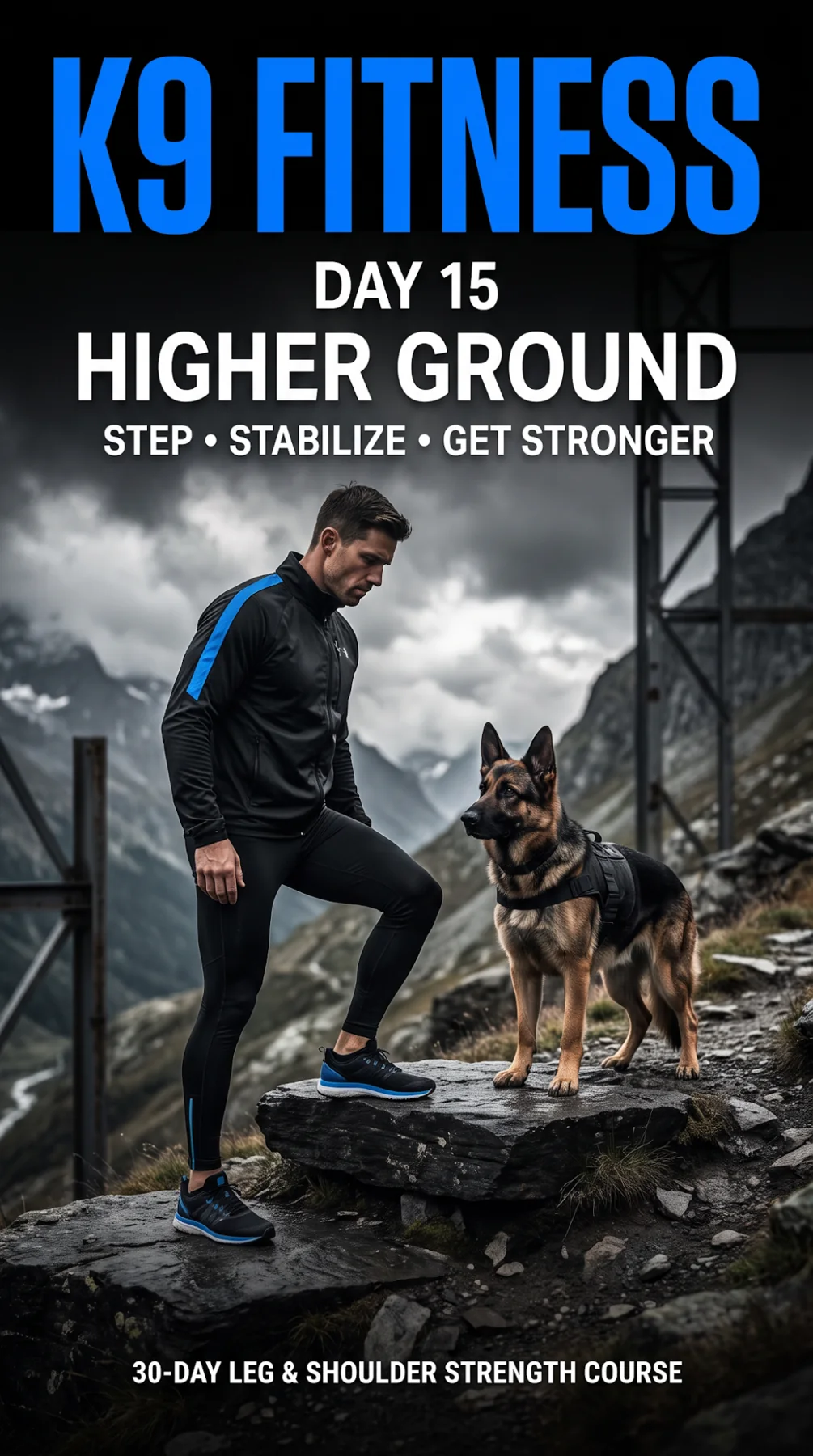
K9 FITNESS — DAY 15 OF 30
HIGHER GROUND
Midpoint Strength Check • Step • Stabilize • Get Stronger
Day 15 is the halfway point, but it is not a max-out test. Day 14 asked you to step, hinge, press, and carry with control; today uses familiar patterns to check whether that control is becoming more repeatable. The goal is to notice what now feels smoother, where balance has improved, which positions still need attention, and how well you recover between sets. Progress at the midpoint should look like better movement before it looks like heavier weight.
That makes today a useful reset as much as a workout. Instead of chasing exhaustion, you will work through a measured session built around leg strength, shoulder stability, single-leg control, and elevation. Each exercise gives you something to observe: can you lower a squat without collapsing forward, press without arching your back, stabilize one hip at a time, and step to a higher surface without rushing? Those details will guide the second half of the course.
WHY THIS DAY MATTERS
A good midpoint check gives you information without demanding an all-out effort. If you can use the same load with cleaner form, complete the same reps with less wobble, or recover your breathing faster than you could earlier in the course, that is meaningful progress. Strength is not only the number on a dumbbell. It is also the ability to create force while staying organized.
Today also adds a “higher ground” theme because elevation changes the challenge without requiring extreme intensity. Stepping up, controlling a lateral step, and stabilizing from a kneeling or single-leg position ask the hips, knees, ankles, shoulders, and trunk to cooperate. That cooperation is what makes strength useful in the real world—on stairs, trails, uneven ground, curbs, work sites, and ordinary family life.
SESSION OVERVIEW
• Target time: 35–45 minutes
• Equipment: one or two dumbbells, a sturdy low step or bench, and a wall or chair for support
• Effort: moderate; stop most sets with about 2 clean reps still available
• Midpoint rule: compare quality, not ego
• Day 15 focus: elevated leg strength, shoulder stability, balance, and controlled capacity
WARM-UP — 6 TO 7 MINUTES
Move through the warm-up at an easy pace. The purpose is to increase body temperature, wake up the ankles and hips, and prepare the shoulders for pressing and stabilization. Nothing here should feel like a test.
1. BRISK WALK OR MARCH — 90 seconds
Walk or march with relaxed arm swing and soft foot contact. Gradually increase your pace without turning the warm-up into cardio work.
2. ANKLE ROCKS — 8 per side
Keep the heel down while the knee moves forward over the toes. Use support if needed and stay within a comfortable range.
3. BODYWEIGHT SQUAT TO REACH — 8 reps
Sit down under control, stand tall, and reach overhead without forcing the shoulders. Keep the knees tracking with the toes and the ribs controlled.
4. REVERSE LUNGE TAP-BACK — 6 per side
Step one foot back, lightly tap the floor, and return to standing. Keep most of the effort in the front leg and use a wall if balance is distracting.
5. WALL SLIDE — 8 reps
Slide the arms upward while keeping the ribs from flaring. Stop before the shoulders pinch or the lower back arches.
6. SCAPULAR PUSH-UP AT WALL OR COUNTER — 8 reps
Keep the elbows mostly straight and let the shoulder blades glide apart and together. Think about moving the upper back rather than bending the arms.
BLOCK A — MIDPOINT STRENGTH CHECK
3 rounds • Rest 60–75 seconds between rounds
The checkpoint is deliberately submaximal. Use a familiar load, or bodyweight if that is what lets you compare movement honestly. Write down one quick note after each round: “steady,” “challenging but clean,” or “needs work.” That short observation is more useful today than chasing a personal record.
1. GOBLET SQUAT TO BOX OR BENCH — 8 reps
Hold one dumbbell at the chest or use bodyweight. Lower for about three seconds, lightly touch the box or bench, then stand with control. Keep the whole foot grounded and the knees tracking in the same direction as the toes. If the depth makes you lose position, raise the target.
FORM CUE: Quiet feet, slow descent, strong stand.
2. HALF-KNEELING ONE-ARM PRESS — 8 per side
Kneel with one knee down and the opposite foot forward. Hold a dumbbell on the same side as the down knee or use the side that feels more stable. Brace gently, squeeze the glute of the kneeling side, and press overhead without leaning backward. Use a lighter load than you would in a standing press.
FORM CUE: Ribs stacked, glute active, shoulder moves smoothly.
3. SUPPORTED SINGLE-LEG RDL — 6 per side
Use one hand on a wall, chair, or rail. Shift weight onto one leg, hinge the hips backward, and let the free leg travel behind you as a counterbalance. Keep the hips mostly square and stop before the spine rounds or the pelvis twists. A kickstand RDL is the easier option.
FORM CUE: Hips back, long spine, support is allowed.
BLOCK B — HIGHER GROUND CONTROL
3 rounds • Rest about 60 seconds between rounds
This block adds elevation and lateral control without turning the midpoint into a punishment session. Keep the step low enough that you can own both the upward and downward phases.
1. LATERAL STEP-UP — 8 per side
Stand beside a low step with the working foot fully planted on top. Drive through that leg to stand, then lower slowly. Keep the knee tracking over the middle toes and avoid pushing hard from the floor leg.
FORM CUE: Whole foot on the step, controlled lowering, hips stay level.
2. FRONT-RACK MARCH — 30 seconds
Hold one or two light dumbbells at shoulder level or hold one weight at the chest. March slowly in place while keeping the torso tall. Do not shrug the shoulders or let the ribs flare as fatigue builds.
FORM CUE: Tall posture, quiet shoulders, steady breathing.
3. INCLINE PUSH-UP PLUS — 8–10 reps
Use a sturdy counter, bench, or wall. Perform a controlled incline push-up, then at the top gently push the surface away so the shoulder blades wrap forward around the rib cage. Keep the body in one line and avoid dropping the head.
FORM CUE: Body moves as one piece; finish with active shoulder blades.
4. WALL SIT + ALTERNATING REACH — 30 seconds
Slide into a comfortable wall sit and alternate reaching one arm forward or slightly overhead. Choose a knee angle you can hold without pain and keep the lower back relaxed against the wall rather than forcing it flat.
FORM CUE: Legs stay steady while the shoulders move.
FINISHER — MIDPOINT CAPACITY TEST
2 rounds • Rest 45 seconds between rounds
• Low step-ups — 30 seconds
• Shoulder taps from a wall, counter, or plank — 20 total
• Calf raises — 15 reps
• Tall standing breathing — 5 slow breaths
The goal is to finish both rounds at nearly the same quality. If round two becomes dramatically sloppier, that is useful information: keep building capacity before increasing intensity. If both rounds look controlled and your breathing settles quickly, that is a sign the foundation is becoming stronger.
MIDPOINT SCORECARD
Take sixty seconds after the finisher and answer these four questions:
• BALANCE: Which side felt steadier today?
• RANGE: Could you move through a comfortable range without rushing?
• CONTROL: Did the shoulders stay organized during presses, reaches, and taps?
• RECOVERY: How quickly did your breathing settle between rounds?
Do not grade yourself as good or bad. Record what you noticed. The second half of the course can now be built on real feedback instead of guesswork.
CANINE PARTNER OPTION — CONTROLLED HILL WALK
If your dog is healthy and comfortable on inclines, take an easy 10–15 minute leash walk on a gentle hill or rolling path later in the day. Keep the pace conversational and use brief pauses for a calm sit, stand, or heel position. The partnership goal is not to exhaust the dog; it is to practice steady movement and control on changing terrain.
Avoid steep grades, repeated jumping, weighted vests, or long stair sessions for puppies, older dogs, dogs with known orthopedic concerns, or any dog showing stiffness, limping, hesitation, or unusual fatigue. Choose cool surfaces, bring water when conditions are warm, and shorten the session when your dog’s gait or enthusiasm changes.
COOLDOWN — 4 TO 5 MINUTES
• Easy walking — 60 seconds
• Standing calf stretch — 30 seconds per side
• Half-kneeling hip-flexor stretch — 30 seconds per side
• Hamstring hinge stretch — 30 seconds per side
• Cross-body shoulder stretch — 30 seconds per side
• Doorway chest stretch — 30 seconds per side
• Slow breathing — 5 relaxed breaths
RECOVERY NOTE
A midpoint workout should leave you informed, not wrecked. Today combines single-leg control, elevation, pressing, and sustained positions, so the smaller stabilizing muscles may feel more worked than they do after a simple bilateral session. Eat normally, include adequate protein and carbohydrate across the day, hydrate, and use easy walking or ordinary daily movement to keep stiffness from settling in.
Pay attention to the difference between muscular fatigue and warning signs. Mild soreness or a worked feeling can be normal after training. Sharp pain, joint catching, sudden weakness, numbness, dizziness, chest pain, or unusual shortness of breath are reasons to stop and seek appropriate medical guidance rather than pushing through.
DAILY MISSION — WRITE DOWN THREE WINS
Before the day ends, write down three things that are better now than they were near the beginning of the course. One might be a cleaner squat. Another might be improved shoulder range, steadier balance, better confidence on stairs, or faster recovery between rounds. These wins do not need to be dramatic to be real.
COURSE PROGRESS — DAY 15 OF 30
You are officially halfway through the 30-day leg-and-shoulder strength course. The first half built the vocabulary: squat, hinge, lunge, step, press, stabilize, carry, balance, and control. Day 15 checks how well those pieces are starting to work together.
The second half can now become more specific. Expect gradually more challenging combinations, longer time under tension, stronger unilateral work, and smarter use of carries, steps, shoulder stability, and controlled power. The goal is not to make every day harder. The goal is to make your movement more capable, durable, and useful.
SAFETY NOTE
This program is general fitness education, not individualized medical care. Use a stable step, bench, wall, or support surface and choose loads you can control through the full set. Do not use furniture that can slide, tip, or collapse. Stop any exercise that causes sharp pain, dizziness, chest pain, sudden weakness, unusual shortness of breath, or another concerning symptom.
If you have a recent injury or surgery, significant joint pain, a condition that affects balance or exercise tolerance, or specific rehabilitation restrictions, use qualified medical or rehabilitation guidance before progressing the program.